A field guide for the living · gathered in quires a to k
Know Well to Die
On the medieval craft of dying well, the habit of remembering that you will, and the dance that takes everyone in the end.
In 1415, around the time of the Council of Constance, an anonymous friar wrote a handbook for the last hours of a life. Plague had emptied the parishes of priests, so the book was built to work even when no priest could come. It told the dying what the devil would say to them, told them what to say back, and told the people sitting by the bed what to do with their hands. This guide follows that book and its strange relatives: the skull on the scholar's desk, the still life that is already rotting while you look at it, and the procession in which popes and infants dance with their own corpses.
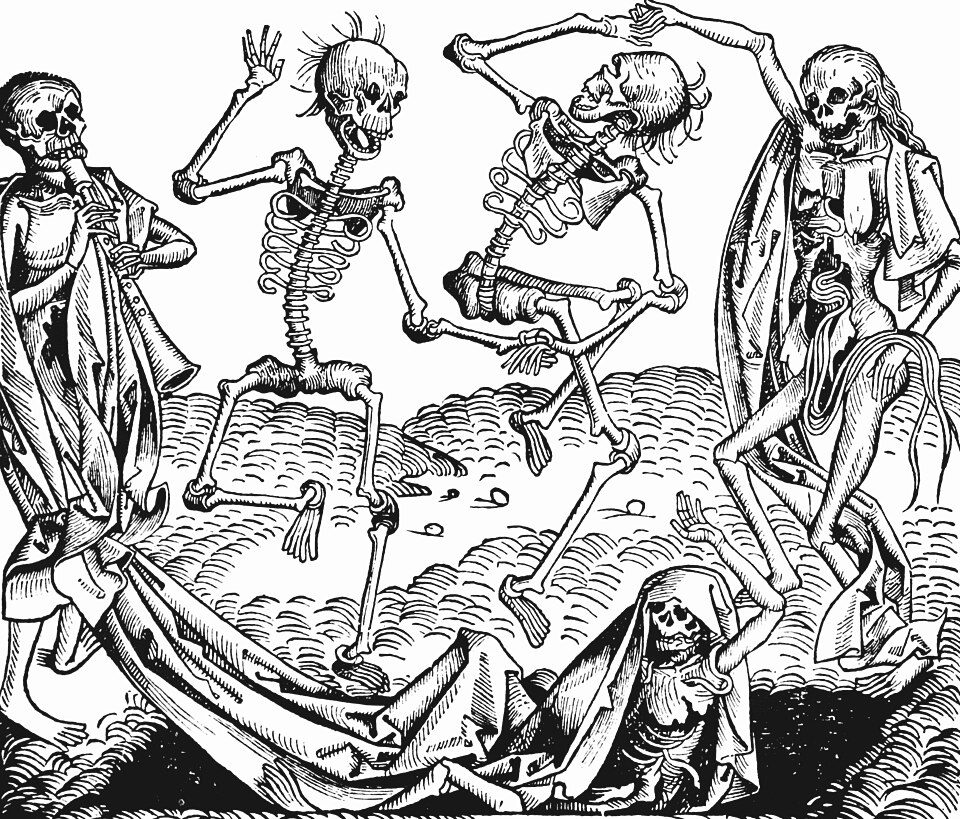
Ultima latet
The last hour is hidden.
The Craft of Dying
Speculum artis bene moriendi, c. 1415 · the illustrated short version, c. 1450
The ars moriendi is really two books. The long one, the Speculum or Tractatus artis bene moriendi, was written around 1415 by an anonymous Dominican friar, probably at the request of the Council of Constance. About three hundred manuscripts of it survive, which makes it a medieval bestseller. A good deal of it leans on Jean Gerson, chancellor of the University of Paris, whose Opusculum tripartitum of the early 1400s closed with a short section on the art of dying.
The long version runs to six chapters, and their order shows what its author thought mattered most:
- Dying has a good side, and a wise person need not fear it.
- The five temptations that come for the dying, and a remedy for each.
- Seven questions to put to the dying person.
- How to imitate the death of Christ.
- Instructions for the friends and family at the bedside.
- Prayers to be said for the dying, by whoever is in the room.
Around 1450, in the Netherlands, someone lifted the second chapter out and turned it into pictures: eleven images, five temptations, five answering inspirations, and a last scene at the hour of death. It became one of the first runaway successes of the new trade in printed books. More than twenty illustrated blockbook editions survive, cut from thirteen different sets of blocks, and the engraver known only as Master E.S. made a set of his own. You did not need Latin to follow it. You needed to be able to tell a devil from an angel.
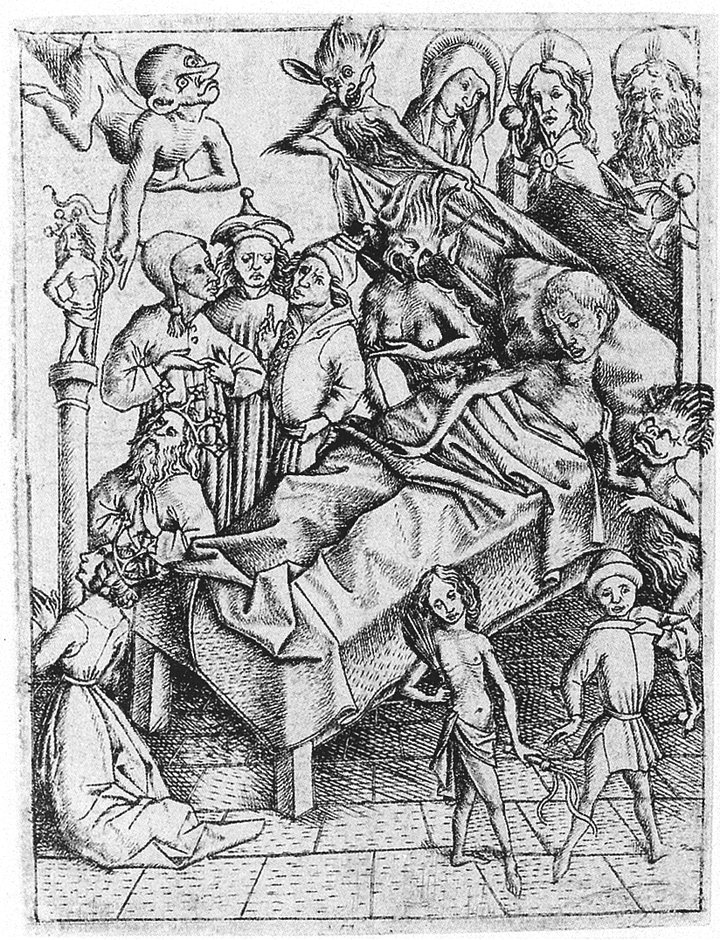
The plot of every temptation is the same. Devils crowd one side of the bed with scrolls in their mouths. Holy figures and an angel crowd the other. Moriens lies in the middle and decides whom to listen to. So, now, do you.
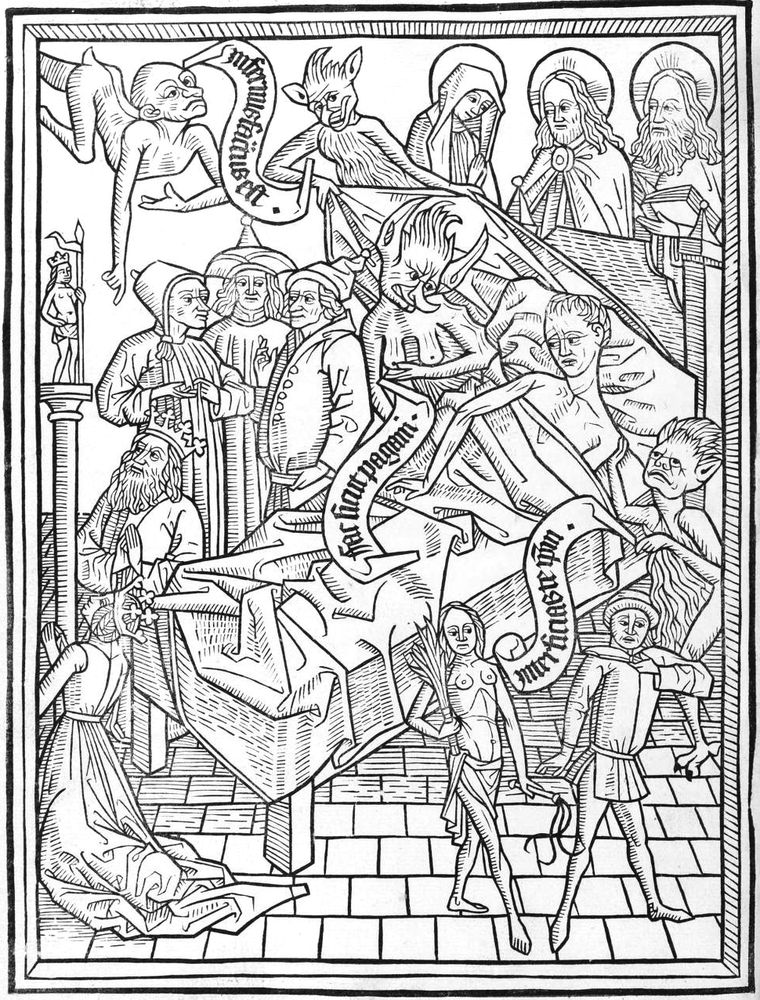
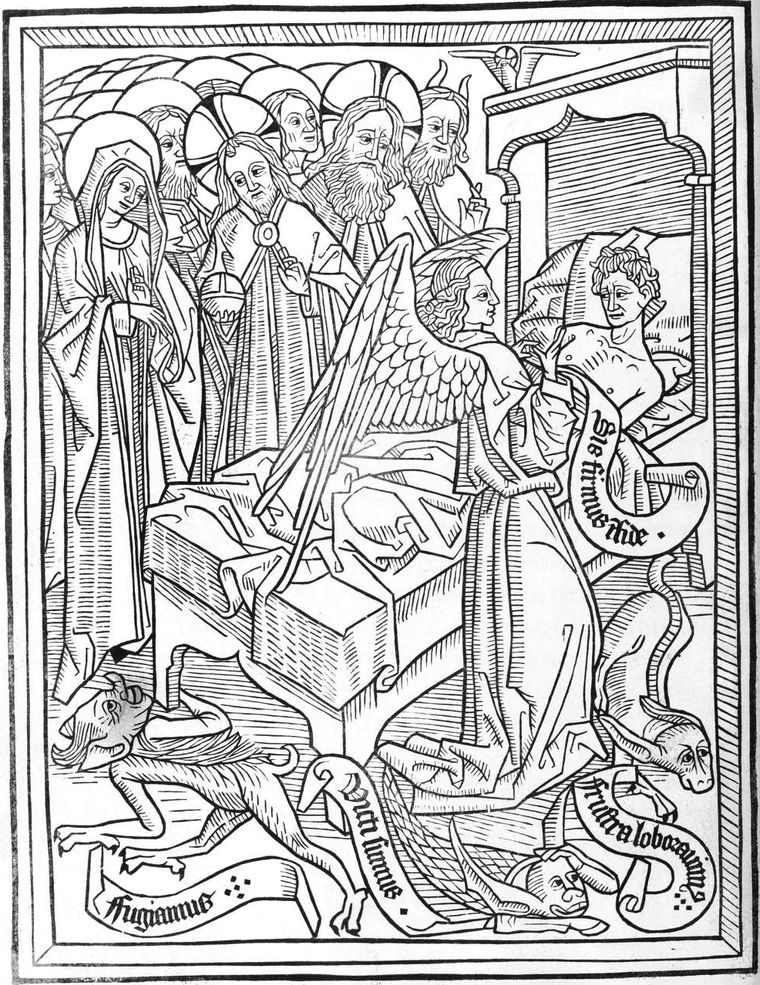
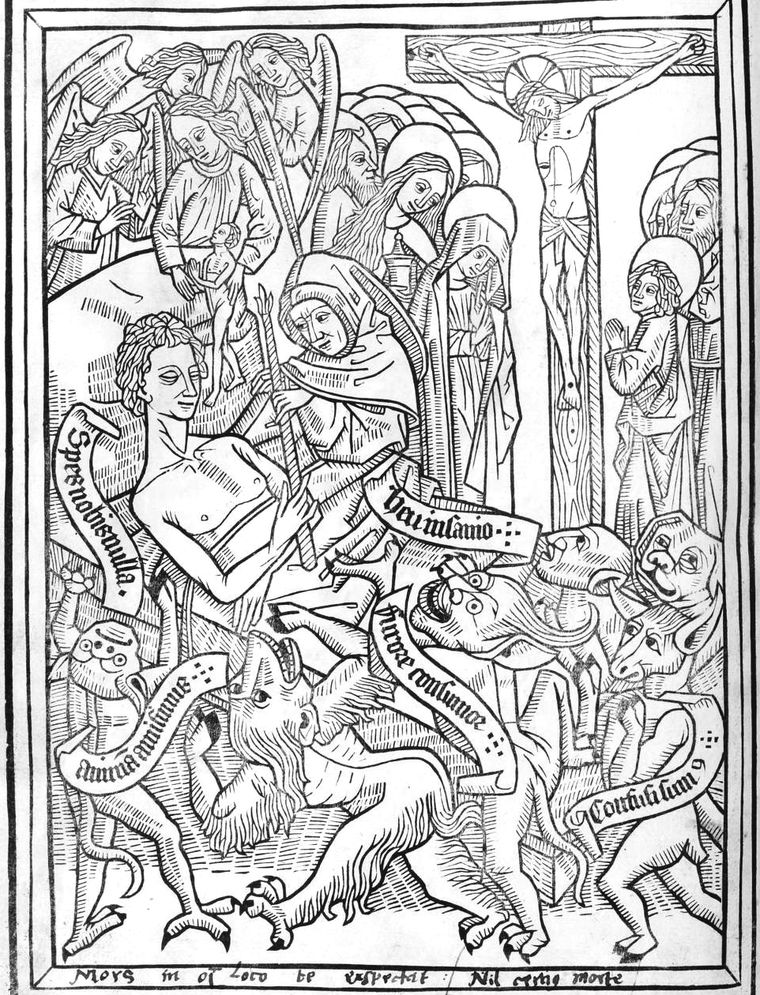
Hora mortis
Woodcuts from the Ars moriendi blockbook, Germany, 1466. Library of Congress, Rare Book and Special Collections Division, Lessing J. Rosenwald Collection, no. 20.
The eleventh woodcut is the one the whole sequence builds toward. A monk puts a lit candle into Moriens’s hand. His soul, a small naked child, is already in the arms of an angel above the bed, under the cross. Below, the devils wail on their scrolls: Spes nobis nulla, Heu insanio, Animam amisimus. No hope for us; alas, I go mad; we have lost the soul. In the Library of Congress copy a later reader has added a line in ink under the frame. It reads, roughly, Mors in quo loco te expectat… nil certius morte: where death waits for you is unknown, and nothing is more certain than death.
A Manual for Amateurs
Chapter V, for the friends and family of the dying
Read the long version now and what stands out is how much of it speaks to the people standing around the bed. The Church wanted any Christian to be able to do this work. A neighbour, a wife, a servant, a child: whoever was there should know what to say, what to read aloud, what not to say, and when to be quiet. That is a job description, and it sits remarkably close to the one an end-of-life doula holds today.
The attendants are warned against comforting the dying with false hope of getting better, since a person who expects to recover will not prepare. They are to place holy images where the dying can see them, read the prayers of the sixth chapter aloud, and keep worldly business from crowding the last hours. That business was meant to be settled earlier, while the dying person still had their wits.
The seven questions
Chapter three gives the attendant a script: seven questions, credited to Saint Anselm of Canterbury, each to be answered with one word, Etiam, “yes.” Beside them is a set you might hear from a doula now. Switch between the two.
- Are you glad that you are dying in the faith?Etiam.
- Do you admit that you have not lived as well as you should have?Etiam.
- Are you sorry for it?Etiam.
- Would you mend your life, if you were given the time?Etiam.
- Do you believe that Christ died for you?Etiam.
- Do you thank him for it?Etiam.
- Do you believe you can be saved only by his death?Etiam.
The attendant’s duties, then and now
Remember That You Will Die
Respice post te; hominem te memento
The habit is ancient. The two-word tag is younger than it sounds. The story usually hung on it comes from Tertullian, writing around 197: a Roman general riding in triumph had a voice behind him in the chariot, telling him to look behind him and remember that he was only a man. The words memento mori are not actually in that story. They arrived later, as a label for something philosophers had been practising for centuries.
On his last day, in Plato’s Phaedo, Socrates tells his friends that people who do philosophy properly are rehearsing for death. Seneca urges his friend Lucilius to rehearse it too, since whoever has learned to die has unlearned slavery. Marcus Aurelius, writing notes to himself on campaign, warns himself not to behave as if he had ten thousand years. Montaigne titled an essay “That to philosophize is to learn to die.” Late medieval and early modern Europe took this old exercise and gave it furniture: a skull on the scholar’s desk, a ring with a tiny skeleton in a coffin for a bezel, a rosary whose last bead is a face on one side and a skull on the other.
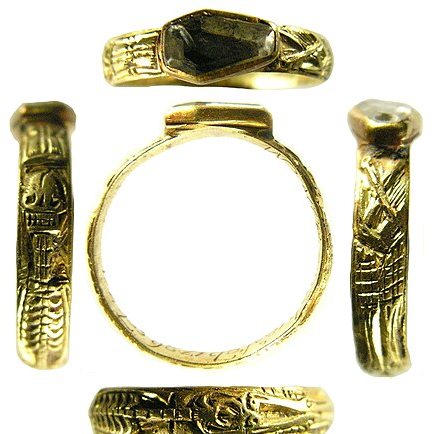
Mors certa, hora incerta
Death is certain; its hour is not.
A medieval proverb, and the reason the ars moriendi exists.
1 of 20 drawn
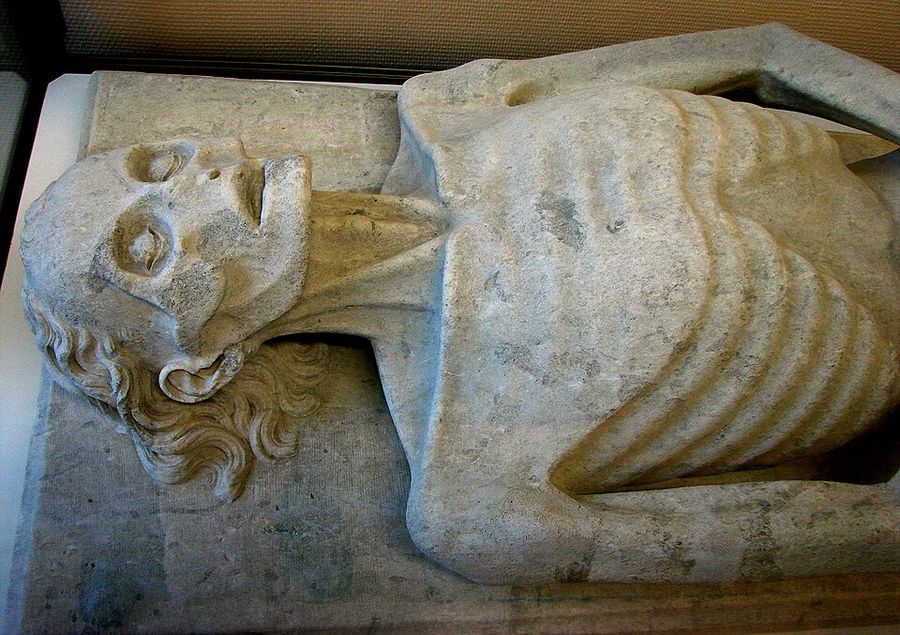
A tomb with two floors
From the late 1300s, some of the rich and the holy commissioned tombs that showed them twice. On the upper slab lies the effigy, robed and serene, the person as they wished to be remembered. Underneath, framed by arches, lies the same person as a cadaver. One of the earliest and most anatomically convincing is the physician Guillaume de Harcigny at Laon, who died in 1393. At La Sarraz, near Lausanne, the knight François de La Sarra is carved with toads and worms at work on his body. Archbishop Henry Chichele had his double tomb installed at Canterbury by 1427 and then lived beside it for another sixteen years, which suggests he meant to look at it.
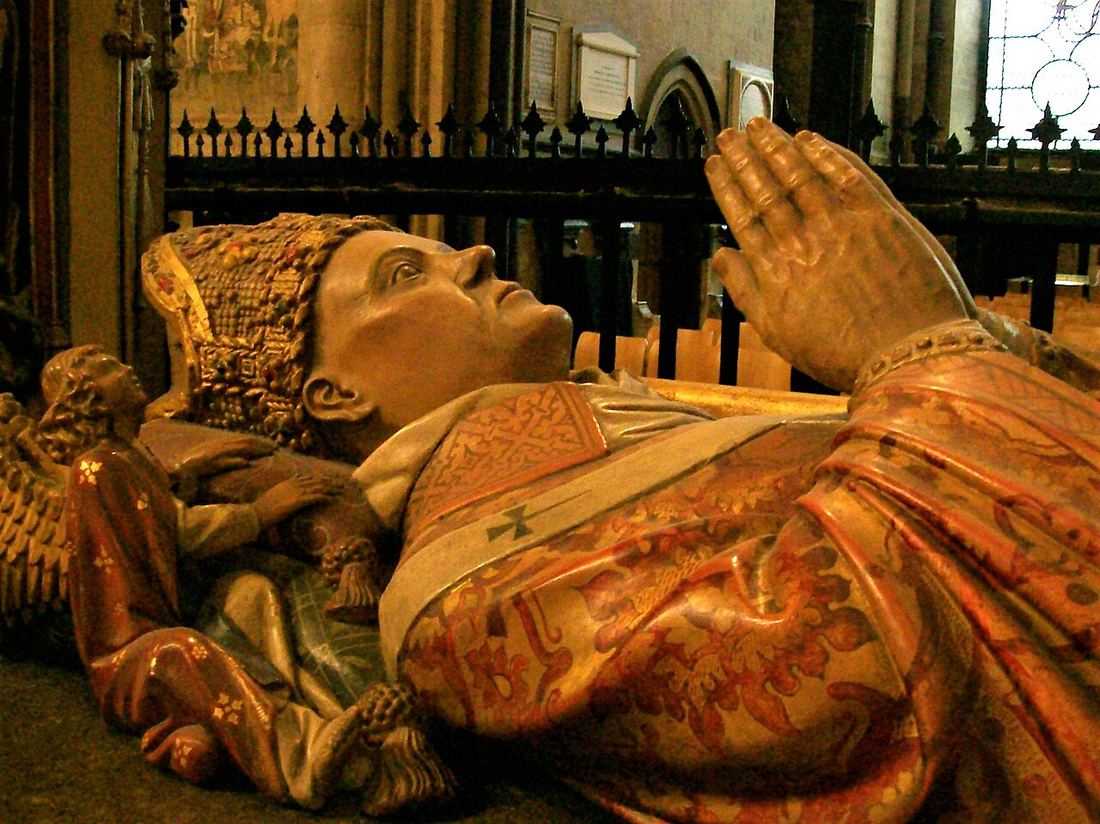
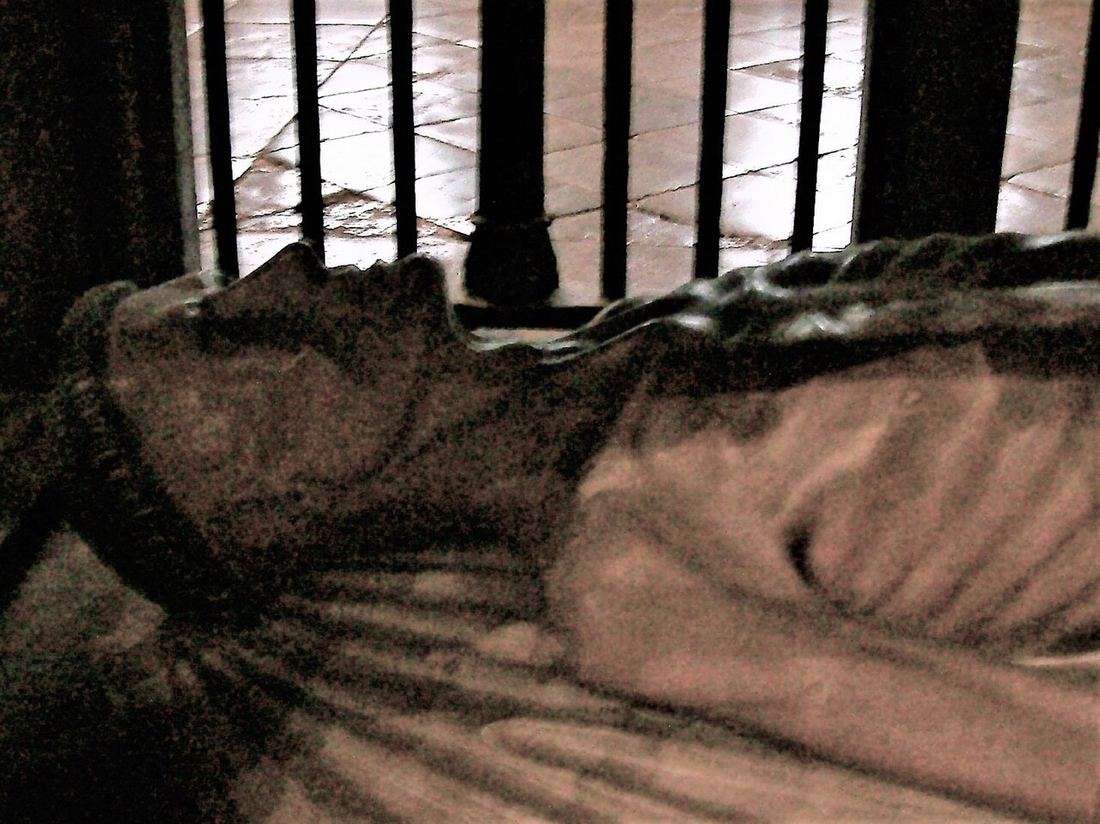
Above: Chichele as he wished to be seen, mitred and vested, painted and gilded, hands joined in prayer.
Photographs by Poliphilo, released into the public domain (CC0).
All Is Vapour
Vanitas vanitatum, omnia vanitas · Ecclesiastes 1:2
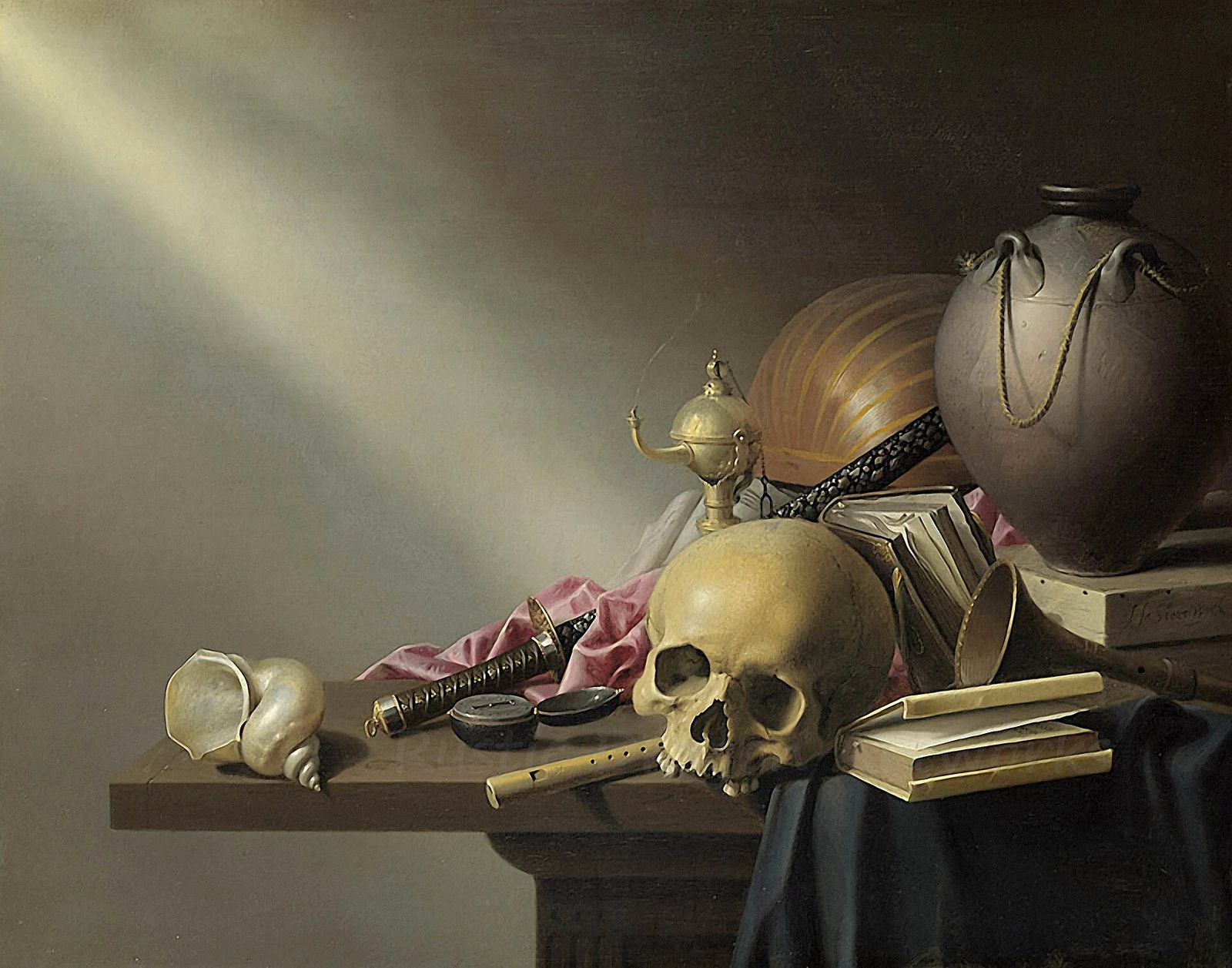
The word comes from the opening of Ecclesiastes in the Latin Bible: vanity of vanities, all is vanity. The Hebrew underneath, hevel, means breath or vapour, the fog your mouth makes on a cold morning. In the Dutch Republic of the early 1600s, and above all in the university town of Leiden, painters turned the verse into a genre: tables of beautiful, expensive, perishable things, with a skull among them. David Bailly is often credited with inventing the type. His nephew Harmen Steenwyck painted its most famous example, An Allegory of the Vanities of Human Life, around 1640. It hangs in the National Gallery in London: a skull lolling on its side in a shaft of light, a lamp just snuffed, a watch, books, instruments, a shell and a Japanese sword.
These paintings are sermons that also show off. The painter makes the lemon peel so convincing you want to taste it, then reminds you that you, the lemon and the painter are all on the way out. Choose the objects on the table to read them.
The table
Natura morta, still life, stilleven
Every object here was chosen because it is lovely, costly or useful, and because it will not last. Choose a number on the painting to read what a viewer in the 1640s would have seen in it.
0 of 11 objects read
Oil on oak, 39.2 × 50.7 cm. National Gallery, London.
The skull that needs you to move
Hans Holbein the Younger painted The Ambassadors in London in 1533. Two young Frenchmen stand beside a shelf of globes, instruments, books and a lute, the full kit of learning and power. Across the floor between their feet lies a long grey smear. From close to the right-hand edge of the painting, it resolves into a skull. Scholars still argue about why he did it. The effect is the argument: death is in the picture the whole time, and you only see it when you leave your usual position.
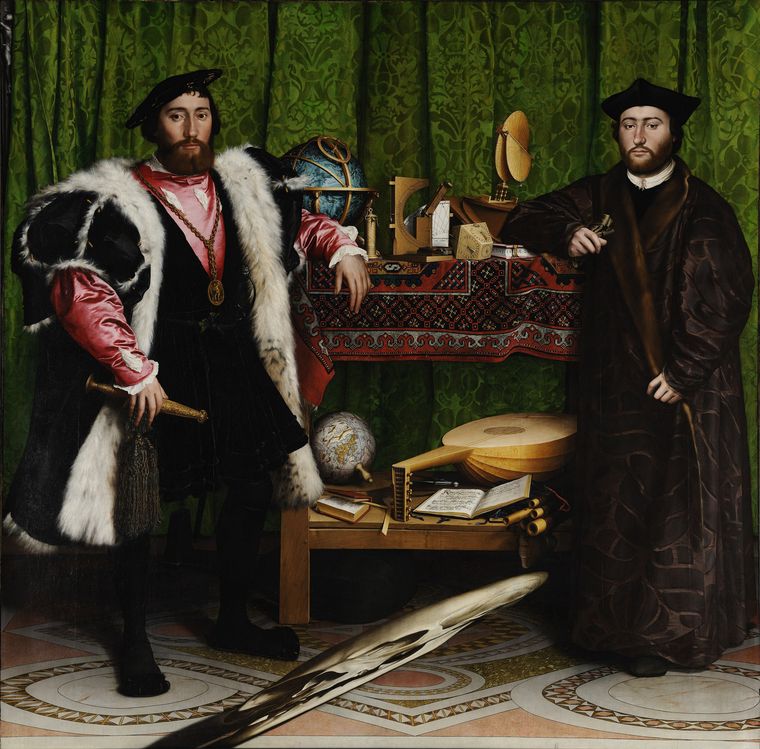
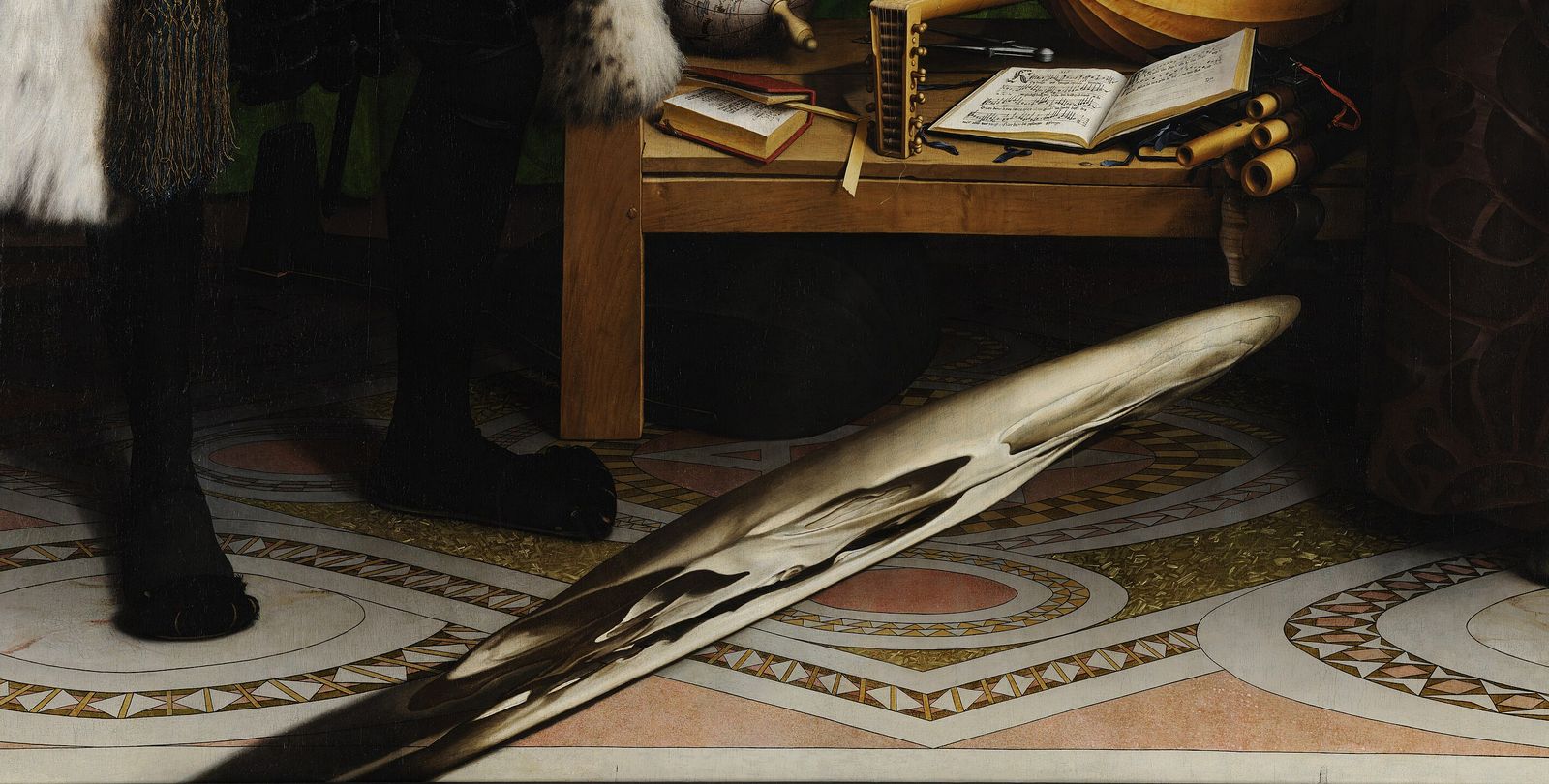
The slider applies the standard correction for Holbein’s stretch to his own paint: turn the image about 25 degrees, squeeze it by a factor of about 2.7, and turn it back.
The Dance That Takes Everyone
Je fis de Macabré la dance · Jean Le Fèvre, 1376
Between August 1424 and Lent 1425, a long frieze was painted along the charnel arcades of the Cemetery of the Holy Innocents in Paris, the city’s largest graveyard, where old bones were stacked in the galleries overhead. It showed the living in strict order of rank: pope first, then emperor, cardinal, king, and on down through the estates to the labourer, the infant and the hermit. A dancing corpse takes each by the hand, and each pair trades verses. The mural was demolished in 1669 to widen a street, but the printer Guyot Marchant had already published it in woodcuts in 1485. The following year he brought out a danse macabre of women.
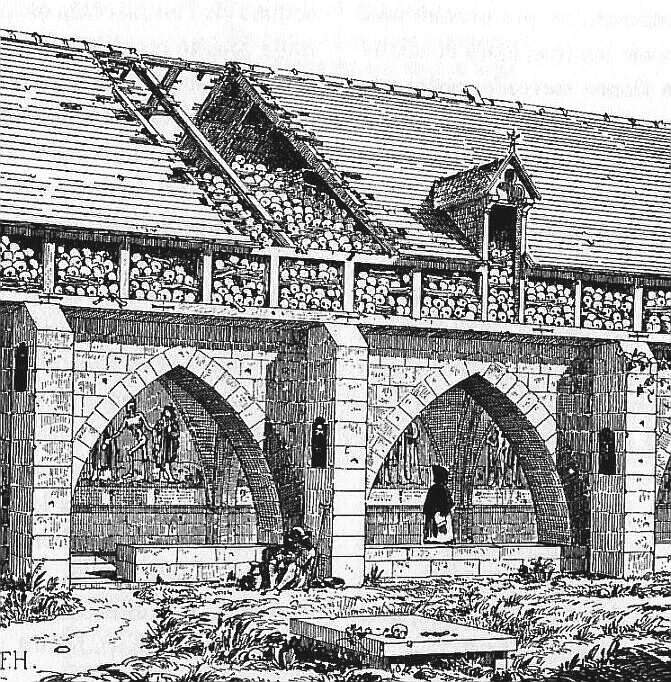
The partner in the Paris dance is not Death with a capital D. In the verses it is le mort, the dead one: each living person’s own double, a little ahead of them in time. When the English poet John Lydgate adapted the Paris text for Old St Paul’s in London, he turned that double into Death himself.
The dead one to the Pope
The Pope answers
Woodcuts from Guyot Marchant’s Danse macabre, Paris, 1486 edition. The verses are new, written in the manner of the Paris dance; the infant’s stammer and the labourer’s complaint echo the originals. A newcomer gets a dead partner from Marchant’s first cut and an empty arch of their own.
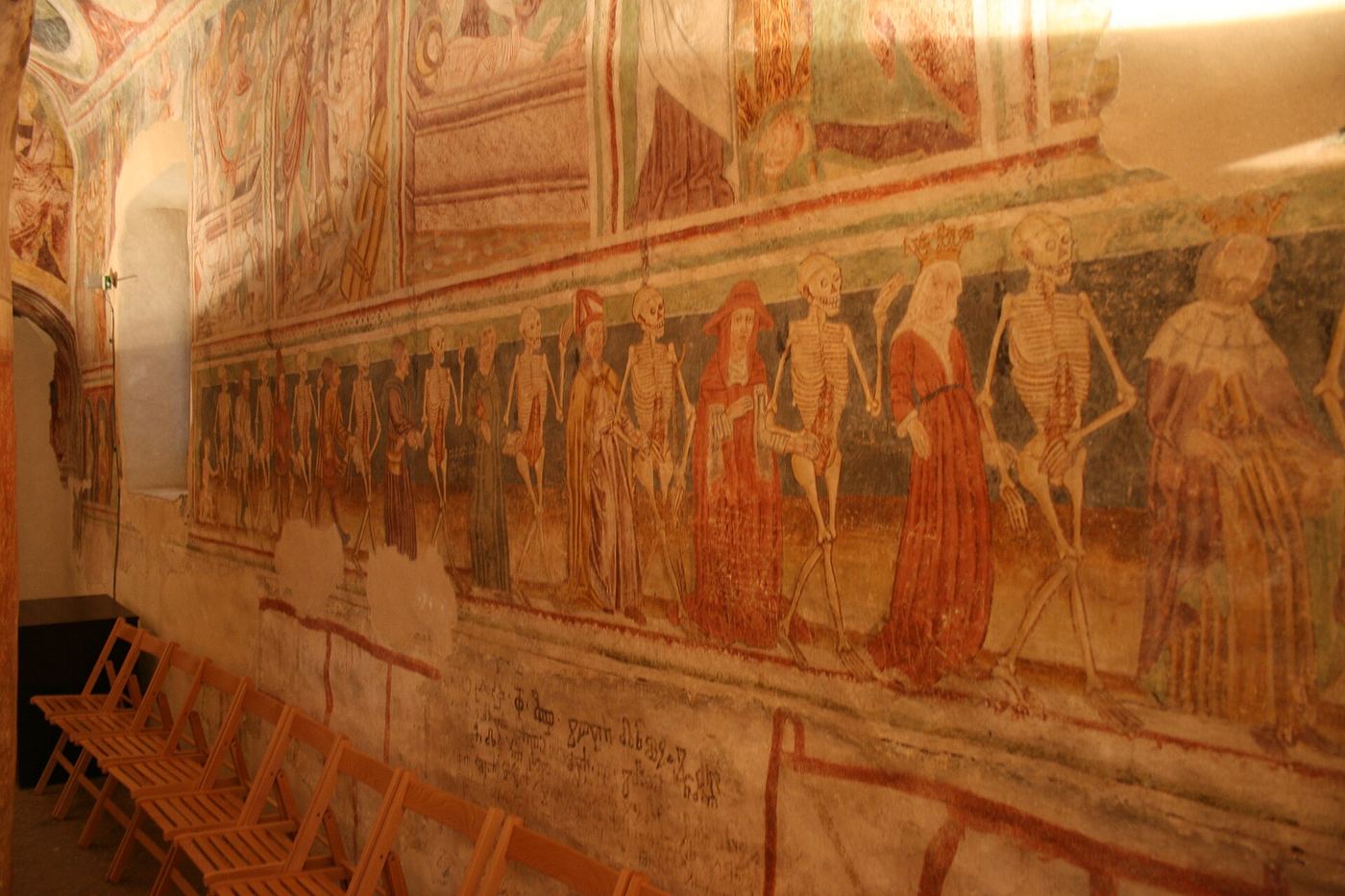
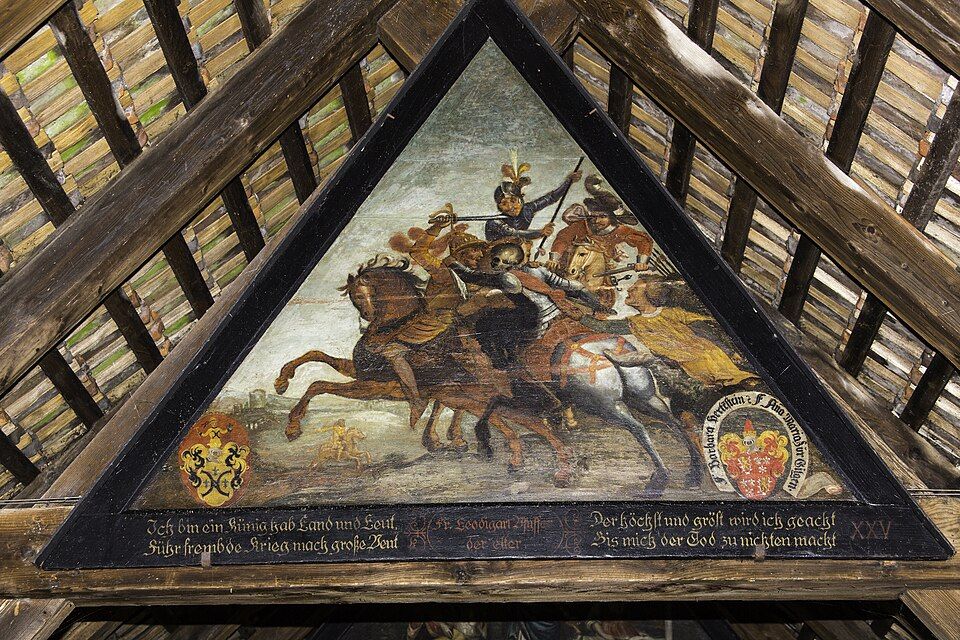
The dance spread across Europe. In Lübeck, Bernt Notke painted one in 1463; it was replaced with a copy in 1701, and the copy burned when the city was bombed in March 1942. In Tallinn, a 7.5-metre fragment from Notke’s workshop survives in St Nicholas’ Church, the only medieval danse macabre on canvas left anywhere. In Hrastovlje, in Slovenia, John of Kastav painted one onto the wall of a small fortified church in 1490. And in Lucerne, between 1626 and 1635, Kaspar Meglinger’s workshop painted 67 triangular panels into the gables of the Spreuer Bridge, so that crossing the river meant walking under the dead. Forty-five are still there.

Lübeck, St Mary’s Church: the 1701 copy of Notke’s 1463 dance, as recorded before it was destroyed in 1942. The town and its ships fill the background.
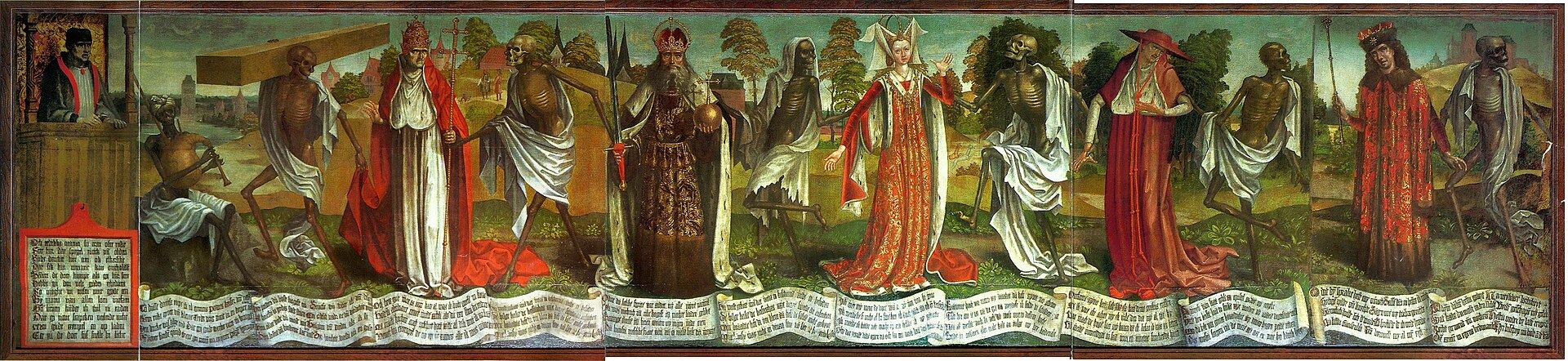
Tallinn, St Nicholas’ Church: the surviving fragment from Notke’s workshop, late 1400s, beginning with the preacher and the piping dead.
Hans Holbein the Younger broke the circle. His designs of the early 1520s, cut into tiny blocks by Hans Lützelburger, show Death catching each person alone, in the middle of an ordinary day. Lützelburger died in 1526 with 41 blocks finished, and the book did not appear until 1538, in Lyon, as Les simulachres & historiees faces de la mort.
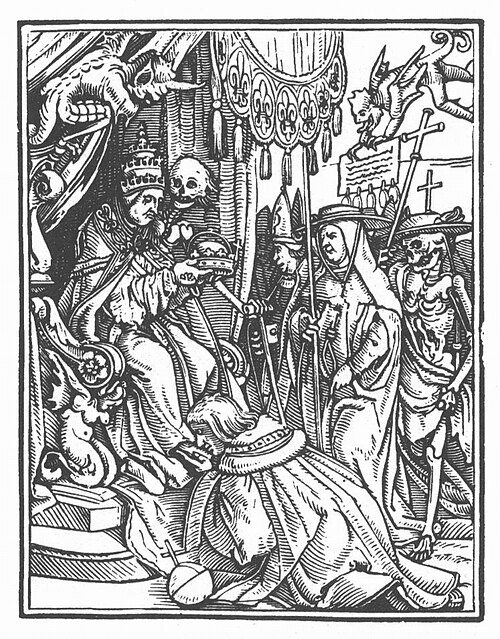
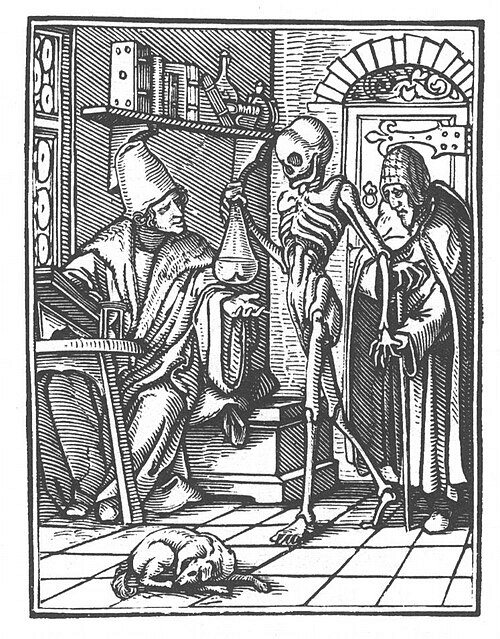
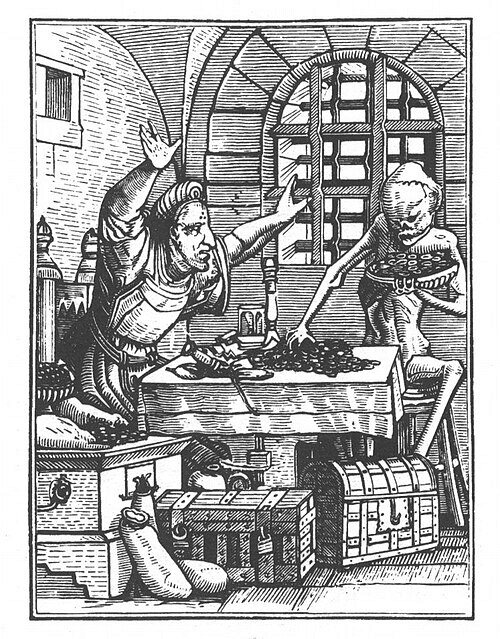
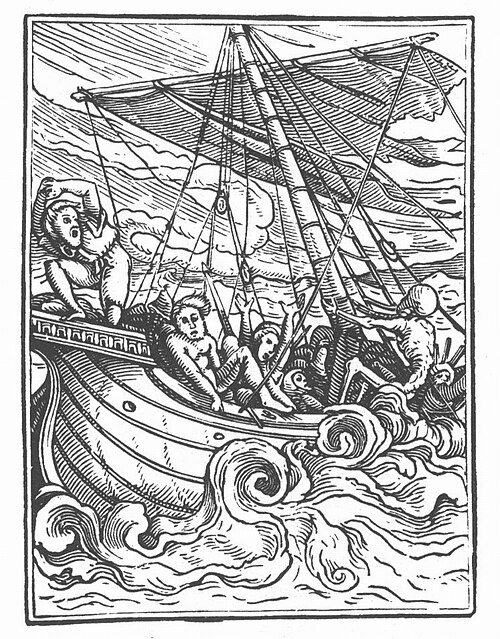
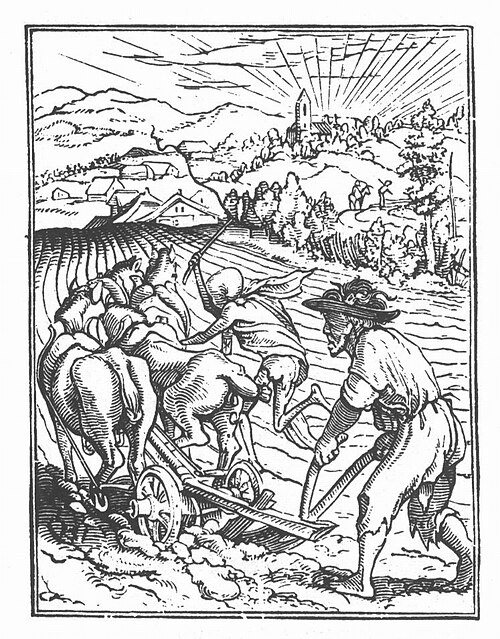
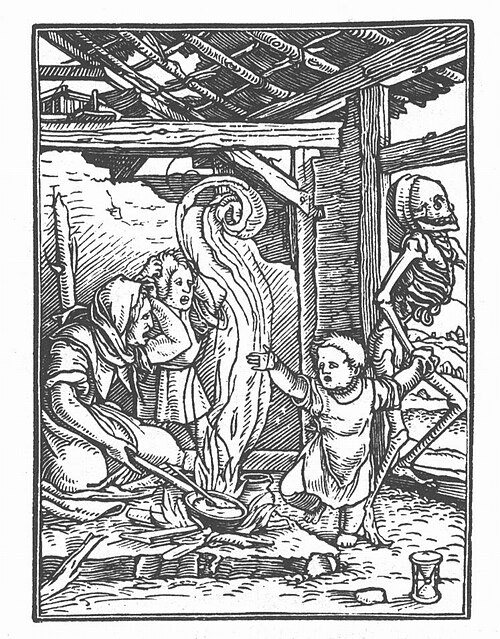
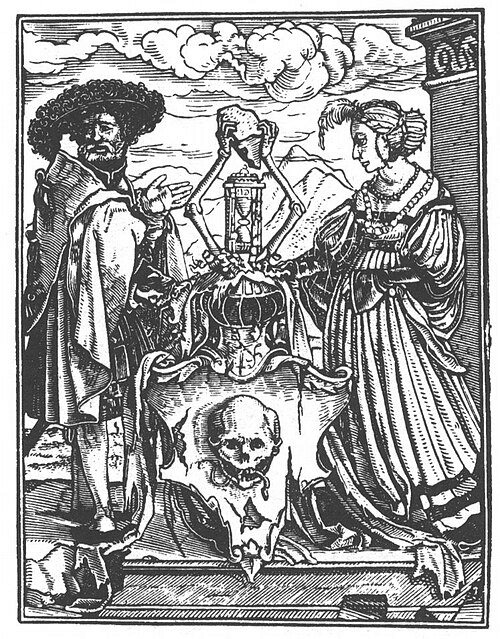
Each block is smaller than a playing card. The book went through about a dozen editions by 1562.
A Cabinet of Adjacent Curiosities
Things kept in the same drawer, for the same reason
The handbook, the skull, the still life and the dance had relatives all over the world, and descendants that are still being born. Open a drawer.
IThe Three Living and the Three DeadFrench verse, 13th century
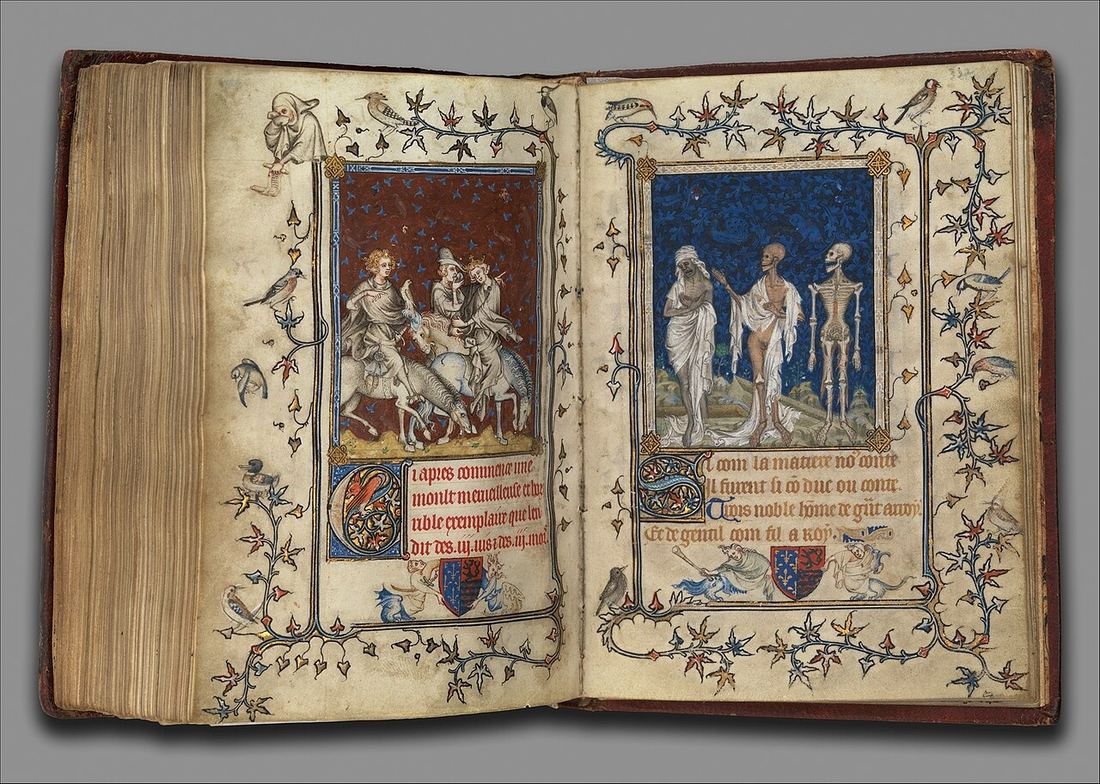
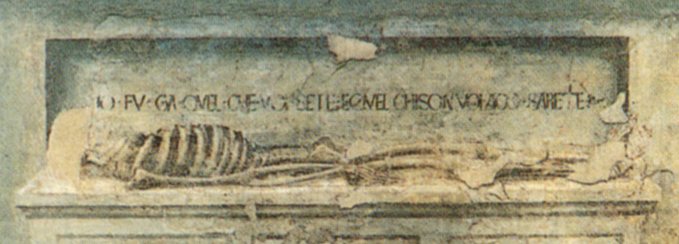
Three young nobles out hunting meet three corpses in three stages of rot. The dead tell them, more or less: what you are, we were; what we are, you will be. The scene was painted on church walls across Europe, often beside a danse macabre. At the Holy Innocents in Paris, the Duke of Berry had it put over the church door years before the dance itself was painted.
The formula travelled. It is carved above the skeleton at the foot of Masaccio’s Trinity in Santa Maria Novella, Florence, painted around 1426 to 1428: Io fui già quel che voi siete, e quel ch’io son voi anco sarete.
IIA Disputation betwixt the Body and WormsEnglish, mid-15th century
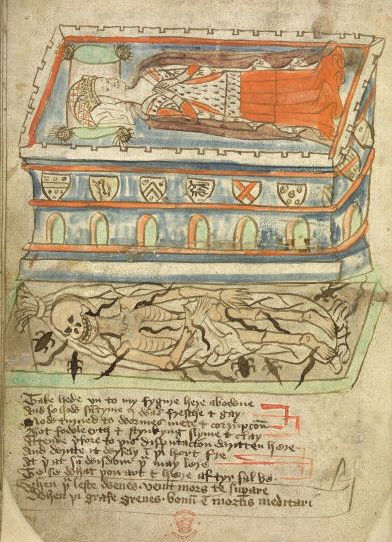
A 218-line poem that survives in a single manuscript, British Library Additional 37049, probably made in a northern English Carthusian house. The narrator, fleeing the plague, shelters in a church, falls asleep beside the tomb of a fine lady, and dreams that her corpse is arguing with the worms eating her.
She is outraged. They are reasonable, even cheerful, and point out that they treat everyone alike. By the end she has come round, and the lady and her worms make their peace. It is the only medieval body-and-soul debate in which the body argues with its own diet.
IIIEverymanEnglish morality play, late 15th century
The ars moriendi as theatre. God sends Death to summon Everyman to his reckoning. He asks his friends to come with him: Fellowship, Kindred, Cousin and Goods all find reasons not to. Beauty, Strength and the Five Wits walk part of the way and turn back at the grave’s edge. Only Good Deeds goes down into it with him.
IVHoly DyingJeremy Taylor, 1651
The English ars moriendi tradition kept going after the Reformation and peaked here. Taylor published Holy Living in 1650 and Holy Dying in 1651, the year his first wife died. Its title page promises rules for the sick and dying “or by others standing in their attendance,” along with rules for visiting the sick. Two centuries on, the people by the bed were still part of the audience.
VBardo ThödolTibet, revealed in the 14th century
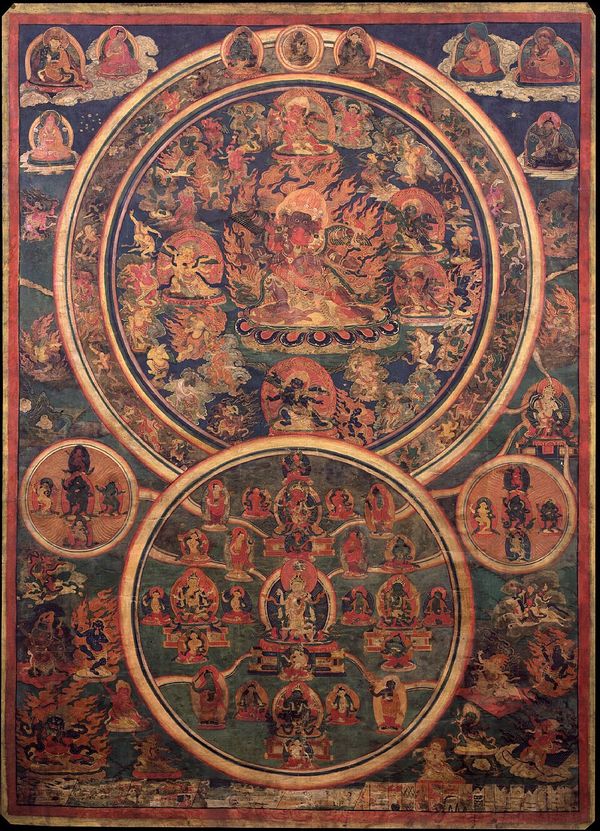
Known in English as The Tibetan Book of the Dead, its title means “Liberation through Hearing in the Intermediate State.” Tradition holds that Padmasambhava composed it in the eighth century and had it hidden, and that Karma Lingpa (1326–1386) found it. It is meant to be read aloud to the dying and the recently dead, guiding their awareness through the bardos between death and rebirth.
It is the nearest thing outside Europe to an ars moriendi, and roughly its contemporary. Like the Paris handbook, it puts the person reading at the bedside to work.
VIKusōzuJapan, images from the 13th century

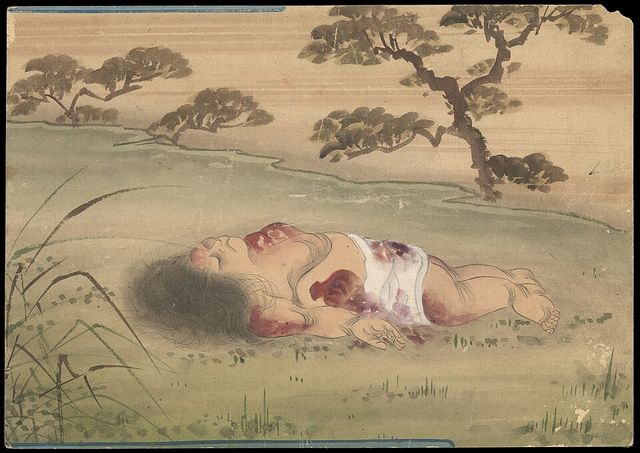
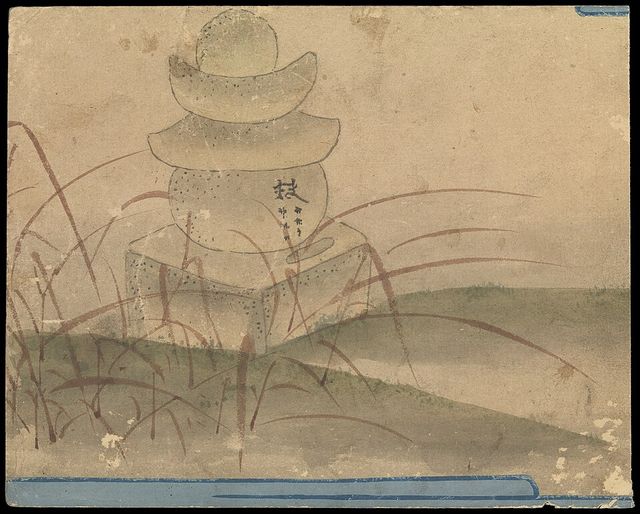
Paintings of the nine stages of a decaying corpse, rooted in a Buddhist meditation on impermanence: the body swells, discolours, is opened by animals, and comes apart until only scattered bones remain. Japanese versions appear from the 13th century, in handscrolls and hanging sets. The set above, probably from the 1700s, is in the Wellcome Collection.
The corpse is almost always a woman, often a noblewoman or courtesan, sometimes shown first writing her farewell poem. The images were used to cool desire in monks, and modern scholars have read the genre’s misogyny plainly. Contemporary painters such as Fuyuko Matsui have taken the form back.
VIIBone chapelsKutná Hora, Évora, Hallstatt, Rome
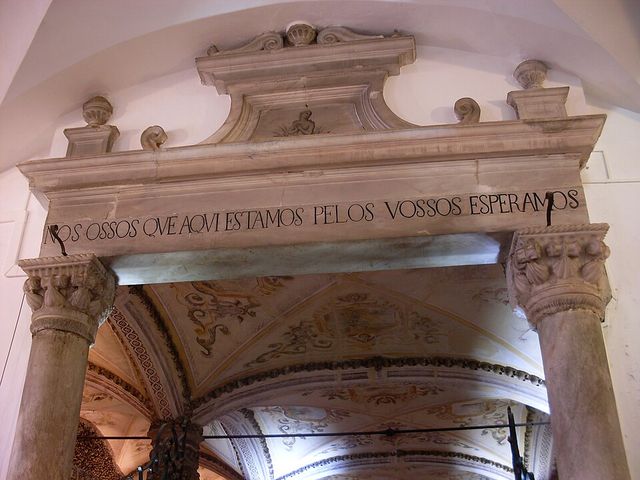
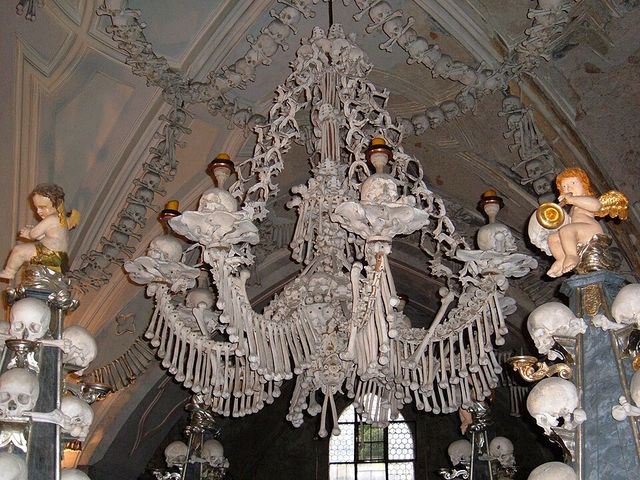
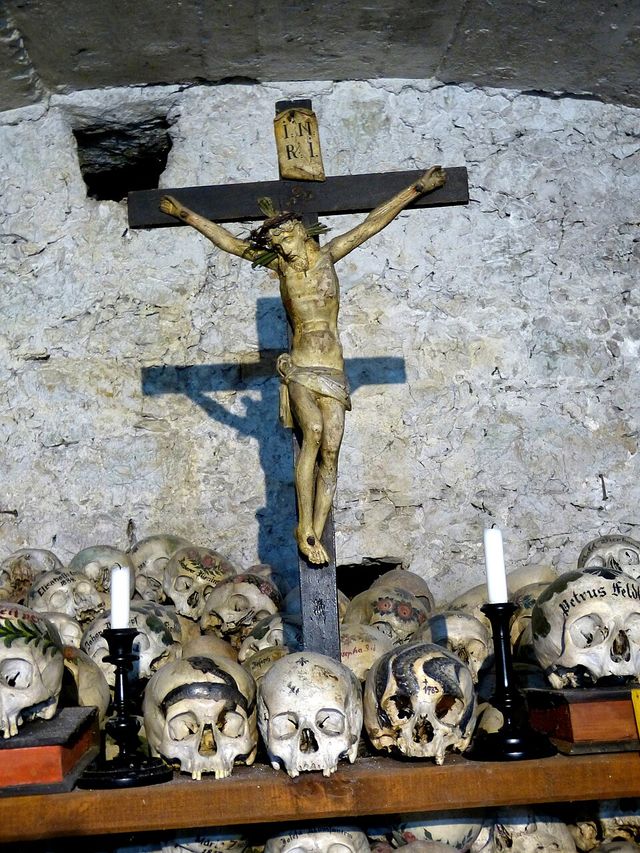
When a churchyard filled, the old bones went into a charnel house. Some became art. At Sedlec, near Kutná Hora, the woodcarver František Rint arranged the bones of tens of thousands of people into chandeliers and coats of arms in 1870. Over the door of the Capela dos Ossos in Évora, Portugal, the bones address you directly: Nós ossos que aqui estamos pelos vossos esperamos, “We bones who are here are waiting for yours.”
In Hallstatt, in Austria, skulls were painted with names, dates and garlands of flowers before being stacked. In the Capuchin crypt in Rome, a placard says the line from drawer I again.
VIIISundial mottosWherever there is a wall and sun
The most memento-mori instrument ever made, because it can only count the hours by watching them pass. Vulnerant omnes, ultima necat: they all wound, the last one kills. Ultima latet: the last one is hidden. A dial of 1821 at Villar-Saint-Pancrace in the French Alps adds Hic umbra, forte tua: here is a shadow, perhaps yours.
And there is Sine sole sileo: without the sun, I am silent. The dial at the top of this page uses it after dark.
IXDeath’s head, cherub, urn and willowNew England, 1600s to 1800s
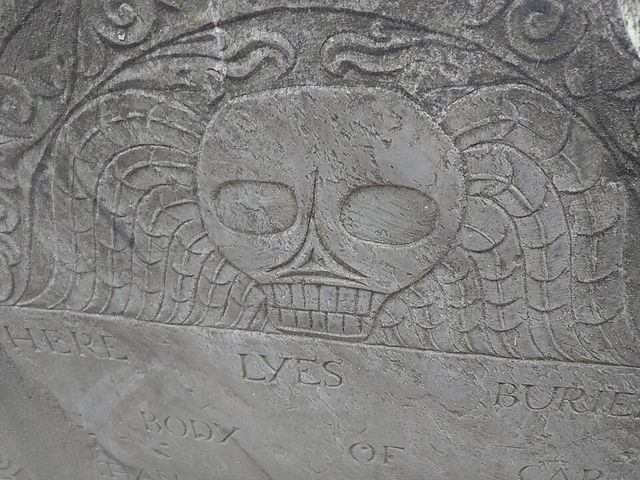
Puritan slate gravestones began with grim winged skulls. Over the eighteenth century the skulls softened into winged cherub faces, and by around 1800 they gave way to an urn under a weeping willow. In the 1960s the archaeologists James Deetz and Edwin Dethlefsen used that drift as a textbook case of how styles rise and fall. Read now, it looks like a culture slowly deciding that death was less a judgment than a sorrow.
XEt in Arcadia egoGuercino, Poussin, 17th century
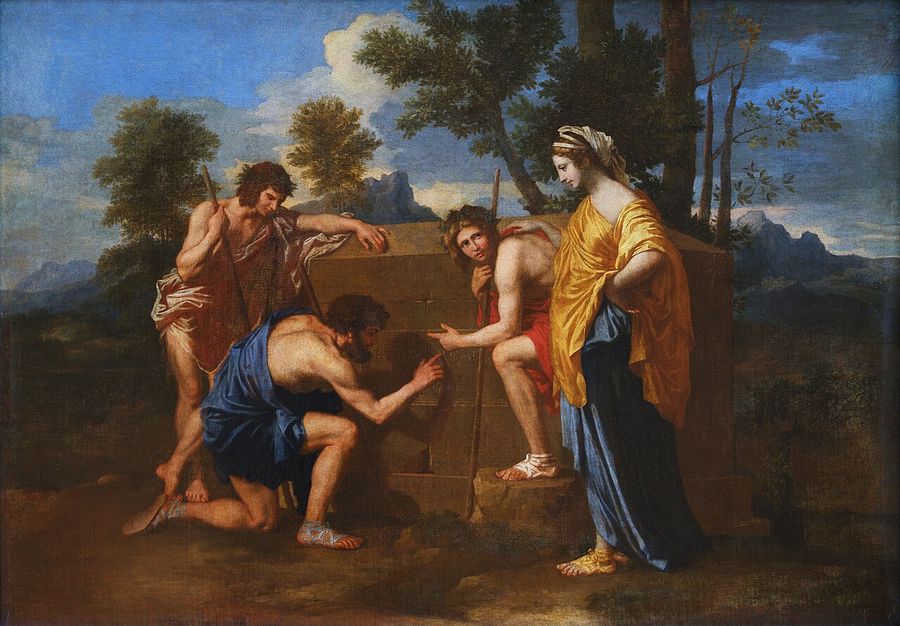
Shepherds in an ideal countryside come upon a tomb, or in Guercino’s version a skull on a ledge, carved with the words Et in Arcadia ego. The speaker is Death: even in paradise, I am here. Poussin painted the scene twice, and later readers softened it into a wistful “I too once lived in Arcadia.” The grammar allows both, which is part of its long life.
XIThe Death CaféSwitzerland 2004, London 2011
The Swiss sociologist Bernard Crettaz held the first café mortel in 2004. Jon Underwood read about him and, with his mother, the psychotherapist Sue Barsky Reid, held the first Death Café in his house in Hackney in September 2011. The rules are few: tea, cake, no agenda, nothing to sell, and it is not grief counselling. Underwood died suddenly in 2017. The gatherings now number in the tens of thousands, in nearly a hundred countries.
XIIThe Seventh SealIngmar Bergman, 1957
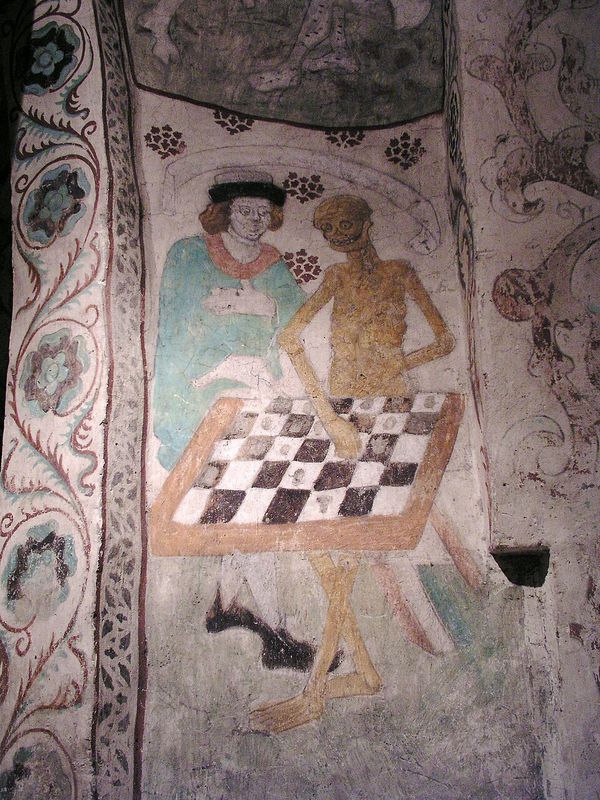
A knight back from the Crusades plays chess with Death to buy time. The film ends with its most quoted image: Death leading a line of the dead, hand in hand, across a hill against the sky. Bergman drew on the painted churches of his Swedish childhood, where Death plays chess on the walls. It is the danse macabre arriving in cinema intact.
The Long Rehearsal
Two and a half thousand years of practising
- 4th c. BCEPlato’s Phaedo: Socrates, on the day of his execution, calls philosophy a practice for dying.
- c. 62–65Seneca’s letters to Lucilius urge him to rehearse death daily.
- c. 170–180Marcus Aurelius writes the notes we call the Meditations.
- c. 197Tertullian describes the voice in the triumphal chariot: remember you are a man.
- 13th c.The Three Living and the Three Dead appears in French verse.
- 1347–51The Black Death kills somewhere between a third and half of Europe’s people, and keeps returning.
- 1376Jean Le Fèvre writes “Je fis de Macabré la dance,” the word’s first known appearance.
- 1393Death of Guillaume de Harcigny, whose cadaver effigy at Laon is among the earliest.
- early 1400sJean Gerson’s Opusculum tripartitum closes with a section on the art of dying.
- c. 1415The long Ars moriendi is written, probably for the Council of Constance.
- 1424–25The danse macabre is painted at the Holy Innocents in Paris.
- c. 1426–28Masaccio paints the Trinity, with a skeleton that speaks.
- by 1427Archbishop Chichele’s double tomb is installed at Canterbury. He dies in 1443.
- c. 1450The illustrated short Ars moriendi appears in the Netherlands: eleven pictures.
- 1463Bernt Notke’s danse macabre for St Mary’s, Lübeck.
- 1485–86Guyot Marchant prints the Paris dance, then a dance of women.
- 1490John of Kastav finishes the danse macabre at Hrastovlje.
- 1519Martin Luther preaches his sermon on preparing to die, and the art of dying turns Protestant too.
- 1533Holbein paints The Ambassadors, skull and all.
- 1538Holbein’s Dance of Death is published in Lyon, twelve years after its block cutter died.
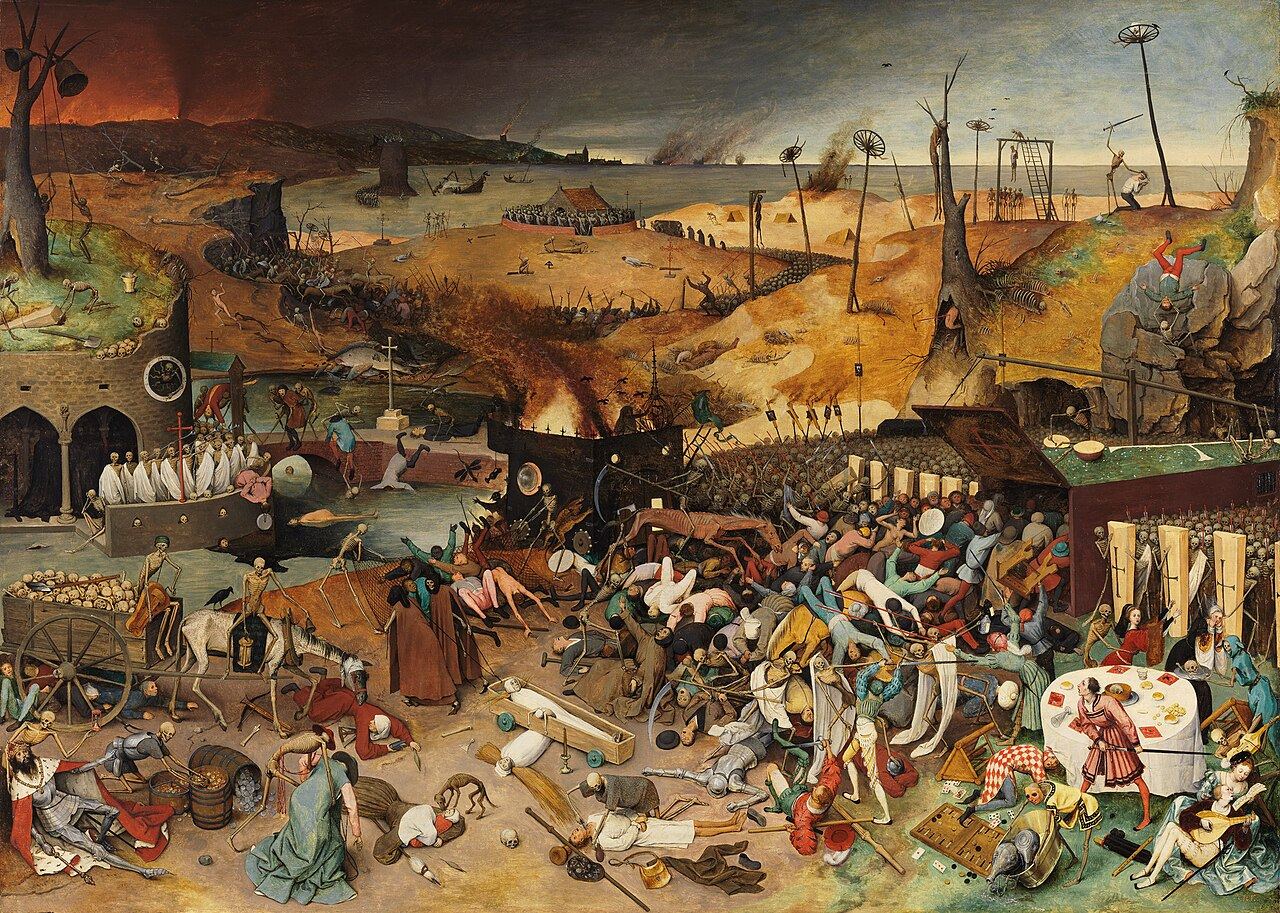
- c. 1562Pieter Bruegel the Elder paints The Triumph of Death: an army of skeletons.
- 1580Montaigne’s Essais, including “That to philosophize is to learn to die.”
- 1626–35Meglinger’s dance of death is painted into the Spreuer Bridge, Lucerne.
- c. 1640Harmen Steenwyck’s Allegory of the Vanities of Human Life.
- 1651Jeremy Taylor’s Holy Dying.
- 1669The Paris mural is pulled down to widen the street.
- 1870František Rint arranges the bones at Sedlec.
- 1874Saint-Saëns, Danse macabre, Op. 40.
- 1942The Lübeck dance is destroyed in an air raid.
- 1957Bergman’s The Seventh Seal.
- 1967Cicely Saunders opens St Christopher’s Hospice in London, and the modern hospice movement begins.
- 2004Bernard Crettaz’s first café mortel.
- 2011The first Death Café, in a house in Hackney.
- 2020Lydia Dugdale, a physician, publishes The Lost Art of Dying, a deliberate twenty-first-century ars moriendi.
A New Ars Moriendi
Five temptations for people who will die in hospitals, with phones
The old book’s structure still works: name the thing that will pull you away from a good death, then give its answer in advance, while you are well enough to listen. Physicians like Lydia Dugdale have argued for exactly this kind of revival. Here is one attempt, keeping the five-part form. The devils have changed their clothes.
The temptation of Later
“There is plenty of time. Nobody you know is dying. Talking about it now is morbid.”The old temptation against faith, reborn as procrastination.
The answer
Mors certa, hora incerta. Choose who will speak for you if you cannot, and tell them what you would want. In Ontario, a power of attorney for personal care puts that choice in writing.
The temptation of the Machine
“Do everything. Every intervention, every time. Stopping is giving up.”Despair dressed as hope: the conveyor belt of treatment nobody chose.
The answer
Ask of each treatment what it is for, and what it will cost in time, comfort and days at home. Some will be worth it. You are allowed to decide which.
The temptation of Silence
“Don’t upset them. Keep it light. They know how you feel.”Impatience turned inward: protecting everyone from the conversation.
The answer
Say the things that are hardest to say before they become impossible. Palliative physician Ira Byock boiled them down to four: please forgive me, I forgive you, thank you, I love you.
The temptation of the Unclosed Accounts
“Your photos, messages and passwords will sort themselves out. Let the profile keep posting birthday reminders.”Avarice, digitized: holding on to everything by never deciding.
The answer
Make an inventory. Name legacy contacts where the platforms allow it. Decide what should be kept, handed on or deleted, and write down where the keys are, so the people who stay are not locked out of your life.
The temptation of the Beautiful Death
“Plan it perfectly. Curate it. Make it the death people will talk about.”Vainglory, the last trap, now with a mood board.
The answer
A good death is the one that fits the person, not the one that would photograph well. Some people want a vigil with candles. Some want the hockey game on. Both are the craft done properly.
Further Reading
For study, gathered in October 2026
The handbook itself
- The Book of the Craft of DyingFrances Comper’s 1917 modern-spelling edition of the English text, with Caxton’s abridgement. Free on the Internet Archive.
- Ars moriendi blockbook, c. 1466–67The Morgan Library’s record, with notes on the order of the temptations.
- Blockbücher aus bayerischen SammlungenDigitized blockbooks from Bavarian collections, including ars moriendi copies.
- Cambridge University Library: Ars moriendiA clear summary of the six chapters, with a woodcut from an Augsburg edition of c. 1470.
- Anselm’s questions to the dyingLatin and English, from the TEAMS Middle English Texts series.
- Ars moriendi, WikipediaA starting point, with all eleven woodcuts.
The dance
- The Paris Dance of DeathPatrick Pollefeys’ site, with Marchant’s woodcuts and dances across Europe.
- Marchant’s Danse macabre, in EnglishA translation of the 1485 book from UNC Greensboro.
- Sophie Oosterwijk, ‘Fro Paris to Inglond’?Doctoral thesis (Leiden, 2009) on the dance in England, Lydgate and the word macabre.
- Notke’s Tallinn fragmentThe surviving canvas in St Nicholas’ Church.
- The lost Lübeck danceHyperallergic on the frieze destroyed in 1942.
- Holbein’s Simulachres, Lyon 1538The Morgan’s first-edition record.
- The Spreuer Bridge, LucerneVisiting the bridge, with a theatre tour of the panels (in German).
Skulls, tables and tombs
- Steenwyck, An Allegory of the Vanities of Human LifeNational Gallery, London, with an audio description.
- Holbein, The AmbassadorsNational Gallery, London.
- Archbishop Chichele’s tombCanterbury Archaeological Trust.
- Cadaver monumentsA survey of transi tombs, from Laon to Bar-le-Duc.
- Sundial mottosAnd for the deep end, Gatty’s Book of Sun-dials (1900).
- Masaccio’s TrinityHow the fresco and its speaking skeleton were made.
Elsewhere and after
- Bardo ThödolEncyclopedia of Buddhism, with the main English translations listed.
- The nine stages of decayAnd a set of eighteenth-century kusōzu watercolours at the Wellcome Collection.
- No Soul, No ExitKarl Steel on the Disputation between the Body and the Worms.
- Taylor, The Rule and Exercises of Holy DyingThe 1651 text, via Early English Books Online.
- What is Death Café?The model, in its organizers’ words.
- Lydia Dugdale, The Lost Art of Dying (2020)A physician’s argument for a modern ars moriendi.
Books with no link, worth the library trip
- Mary Catharine O’Connor, The Art of Dying Well (1942)The foundational study of the ars moriendi’s development.
- Nancy Lee Beaty, The Craft of Dying (1970)The English tradition, from the handbook to Jeremy Taylor.
- Philippe Ariès, The Hour of Our Death (1977, English 1981)The sweeping history of Western attitudes to death.
- Elina Gertsman, The Dance of Death in the Middle Ages (2010)Image, text and performance.
- Paul Binski, Medieval Death (1996)Ritual and representation, short and very good.
For the rest of the world’s shelf, from the Pyramid Texts and the Bardo Thödol to Genshin’s deathbed rules and Korean living funerals, see the companion guide, Books of the Crossing.
Picture credits
Every picture here is in the public domain or under an open licence. Images have been cropped and resized, and the black-and-white prints have been tonally adjusted so they sit on the page.
- Ars moriendi blockbook, Germany, 1466, eleven woodcuts. Library of Congress, Rare Book and Special Collections Division, Rosenwald Collection 20. No known restrictions
- Master E.S., Temptation against faith, engraving, about 1450. Public domain
- Nuremberg Chronicle, dance of death, workshop of Michael Wolgemut, 1493. Public domain
- Memento mori ring, PAS find 479274. Photograph: Museum of London. CC BY-SA 4.0
- Chichele tomb, upper tier and lower tier. Photographs: Poliphilo. CC0
- Cadaver effigy of Guillaume de Harcigny, Laon. Photograph: Vassil. Public domain
- Harmen Steenwyck, An Allegory of the Vanities of Human Life, about 1640. National Gallery, London. Public domain
- Hans Holbein the Younger, The Ambassadors, 1533. National Gallery, London. Public domain
- Guyot Marchant, Danse macabre, Paris, 1486: cuts 2, 3, 4, 7, 14, 15, 17, 20 and 21 of the series. Public domain
- The charnel of the Holy Innocents, reconstruction by Theodor Hoffbauer, 1870s. Public domain
- The Lübeck dance of death, 1701 copy after Bernt Notke. Public domain
- The Tallinn dance of death, workshop of Bernt Notke. Public domain
- The Hrastovlje dance of death, John of Kastav, 1490. CC0
- Spreuer Bridge panel, Lucerne. Photograph: Foto-Max 1234. CC BY-SA 4.0
- Hans Holbein the Younger, Dance of Death, Lyon, 1538: plates 6, 26, 28, 30, 38, 39 and 41. Public domain
- Jean Le Noir, Psalter of Bonne of Luxembourg, about 1348–49. Metropolitan Museum of Art. Public domain
- Masaccio, Trinity, about 1426–28, detail. Public domain
- British Library, Additional MS 37049, folio 32v. Public domain
- Thangka of the peaceful and wrathful deities of the bardo. Public domain
- Kusōzu: the death of a noble lady and the decay of her body, Wellcome Collection, images L0070288, L0070291 and L0070296. CC BY 4.0
- Capela dos Ossos, Évora. Photograph: PESP. CC BY-SA 3.0
- Sedlec ossuary chandelier. Photograph: BrokenSphere. CC BY-SA 3.0
- Hallstatt charnel house. Photograph: Wolfgang Sauber. CC BY-SA 4.0
- Death’s head gravestone, Boston. Photograph: CoolGuySlate. CC BY-SA 4.0
- Nicolas Poussin, Les Bergers d’Arcadie. Musée du Louvre. Public domain
- Albertus Pictor, Death playing chess, Täby church. Public domain
- Pieter Bruegel the Elder, The Triumph of Death, about 1562. Museo del Prado. Public domain
Explicit
Here ends the book. If you watched the candle in the corner, it has been burning since you arrived, and it goes out about now. That was the whole lesson of the genre, done once more with feeling.
Set in IM Fell, the types bequeathed to Oxford by Bishop John Fell in the 1680s, and Unifraktur Maguntia. Signatures run a to k without a j, as early printers’ alphabets did. The pictures are old: woodcuts, paintings, tombs and walls, all in the public domain or openly licensed, with credits above. The dance verses and the mottos’ English are new.